
On January 1, you started creating your goals and vision board. It included saving for upcoming trips, clearing debt, building a strong savings account, and everyday expenses. I would say most of my friends and I started planning for upcoming trips and dealing with inflation, and natural disasters.
Personally, for me, I am focused on my savings while building on top of what I have. As we all know January 2025 has been the longest month. Having to deal with the LA fires and luckily I had enough to get a hotel and a ticket out of LA for the week. It made me realize that I wanted to have a stronger cushion in my savings. I wanted to build on my emergency fund for these situations. I wanted to build my savings for my passion projects and travel as much as I could throughout 2025.
In this post, I’ll cover the main things that I’m saving for and how you can save for them. I am also going to highlight that I am not a financial consultant. This post is to be used as a basic foundation to help you with your saving goals. I am building on my retirement savings, creating separate savings accounts and a high-yield savings account.

The Importance of Your Savings
As we go through these unstable times with politics, the economy, and more in the world. This is the time to start saving as we see inflation costs continue to rise in groceries, gas, and the general cost of living! Starting to save now helps give you future security for those times of an unexpected natural disaster, job layoff, or family emergency. I’ve learned that you truly have to be prepared for anything after going through the crazy rollercoaster of January 2025 in Los Angeles.
I’m learning that having multiple savings accounts and being more intentional about how I handle my money. It will allow me to maintain more flexibility to enjoy my passions of traveling, self-care, and rewarding myself now and then. As I talk to different people, we all might have different saving goals but one thing that we have in common is that we don’t want to feel financially unstable.
Building Your Retirement
You hear different people talk about 401(k) & Roth IRA when you start talking about retirement. In my early 20s, I didn’t take it seriously and didn’t even think about doing it when I first transitioned from a part-time to a full-time employee. It wasn’t probably until the end of my first full-time job that I applied for the 401(k). My second job is where I signed up as soon as I was hired. I’m thankful that I did because I saw that grow quickly in the 2.5 years that I was there. I ended up keeping my 401(k) with the bank Fidelity even after I left because they were amazing.
Fidelity has great financial consultants, anytime I spoke with them on the phone. Their website is easy to navigate and understand. I have the app on my phone to check on my money. The company of my first job went under and I forgot to roll over my 401(k) and they sent me the check of what I had since they were closing the account. Fidelity helped me in deciding to put that money into a Roth IRA.
Retirement Breakdown
Below you will find information on what a 401(k) and a Roth IRA are and the differences that you can use to compare which is best for you.
401(k)
- Tax Treatment: Contributions are pre-tax, reducing taxable income now, but withdrawals in retirement are taxed
- Employer-Sponsored: Offered by employers, often with matching contributions. I recommend increasing your % during your annual raise
- Contribution Limit (2025): $23,000 (or $30,500 if 50+ yrs old)
- Withdrawal Rules: Penalty for withdrawing before age 59 1/2 unless an exception applies
Roth IRA
- Tax Treatment: Contributions are after-tax, but withdrawals in retirement are tax-free
- Individually Managed: Not tied to an employer
- Contribution Limit (2025): $7,000 (or $8,000 if 50+ years old), with income eligibility limits
- Withdrawal Rules: Contributions can be withdrawn anytime, but earnings have restrictions
If you want to receive immediate tax savings, go with a 401(k). If you prefer tax-free withdrawals later, a Roth IRA is better. I’m contributing to both for a balanced tax strategy. This year, I’m focused on trying to contribute at least $50-100 every month to my Roth IRA. I haven’t put focus into it since I deposited that one check. So I look forward to growing it this year.
Separate Savings Accounts
One of my challenges in 2024 was wealth and trying to build my savings and pay down my credit cards. I told myself that in 2025, we are getting serious about money! We are getting too old to be mismanaging our money. At the same time, I give myself grace because of the state of the economy and all the different financial factors that have come into my life.
This year I’m putting myself in different saving goals such as building my high-yield savings account. This is a savings account that offers a significantly higher interest rate than a traditional savings account which helps your money grow faster over time.
- Higher Interest Rates: Typically 10-20x the national average of regular savings account
- Safe & Secure: FDIC or NCUA insured, meaning your money is protected
- Easy Access: Allows withdrawals and transfers while still earning interest
- Best for: Emergency funds, short-term savings goals, and holding extra cash
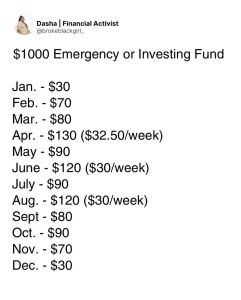
I have my HYS account with American Express which is currently gaining 3.80% APY (Annual Percentage Yield). It is an online HYS account which is great because it’s not in my view unless I’m adding money into it. I try very hard not to take money out of this account. One of my goals with this account is to add $1,000 by the end of the year. I saw someone post a breakdown of how much you should save every month to get to $1,000 by the end of the year. The breakdown is posted below:
Conclusion
I also have my regular savings account with my normal bank which I use to save for trips or any other purchases that I want to make for myself. I’m learning to start making multiple savings accounts for travel, luxury expenses, emergency funds, and more. The tool that I’ve been using is Chase has a budget & goal tracker in their app. It’s perfect because I can see where I spend the most and it incorporates my expenses. I know a lot of people have other apps that they’ve found helpful for them.
I also created a budget tracker that is printable for those who like to see it visually. I’ve learned that I also like to sit down once a month and build out how I can save money while paying down debt. You can get this budget tracker by signing up for my newsletter! I hope this post helps anyone who is on their financial freedom journey. No matter if you are at the beginning, middle, or the end! 💰🙂